How did Vučić lose power, and how did the Student List win Serbia’s election?
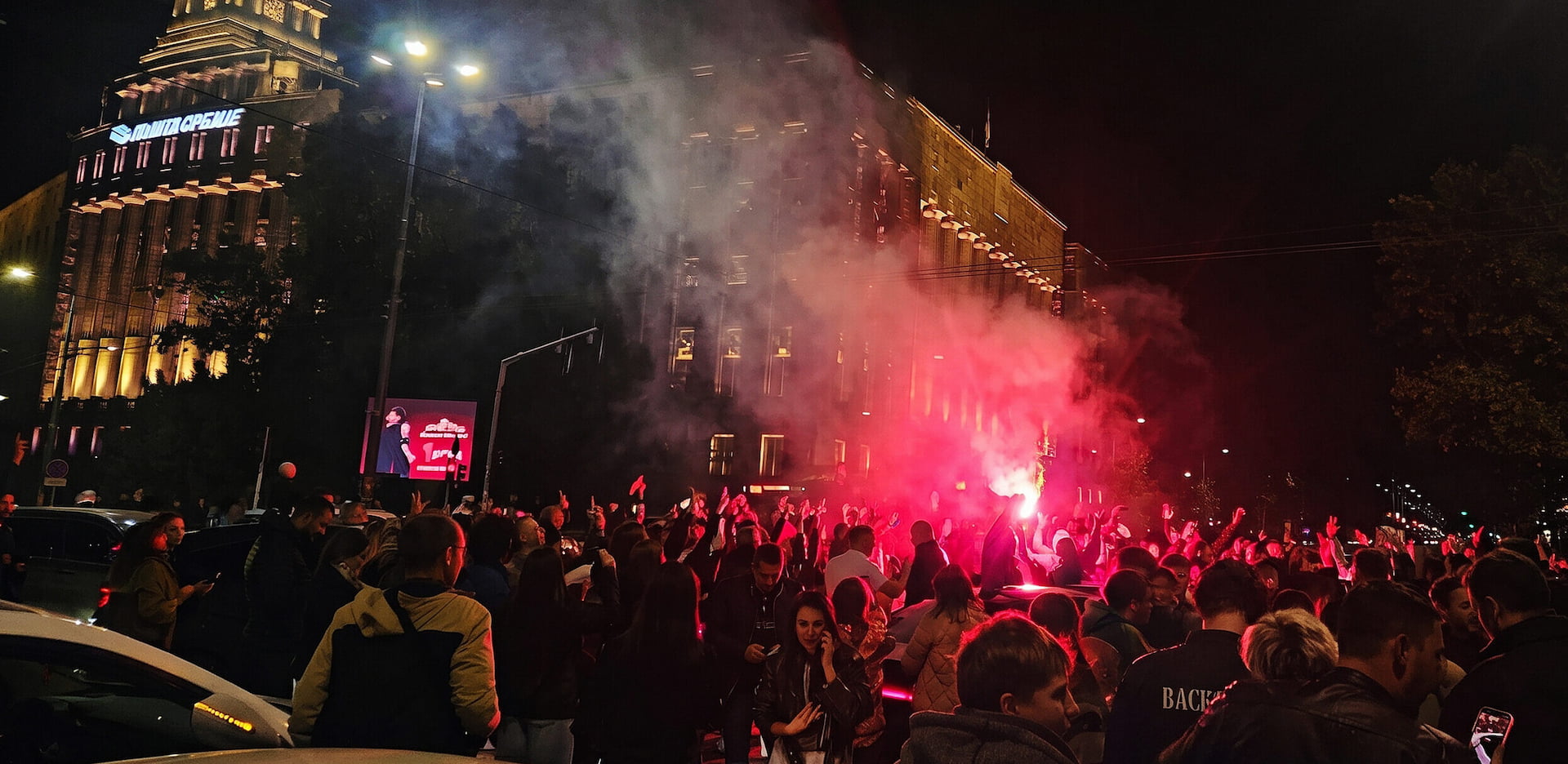
After nearly two years of protests against corruption and a lack of accountability, a movement that emerged from Serbia’s universities defeated Aleksandar Vučić at the ballot box.
What did Albanians in Serbia win?

The government responded by portraying the protests as an attempt to destabilize Serbia. During the election campaign, Vučić also claimed that students were funded by foreign agents, an allegation they denied, insisting that they were demanding the rule of law and functioning institutions. Under pressure from the protests, Vučić resigned as president in September and ran for prime minister in the snap election.
For years, traditional opposition parties had failed to turn discontent with Vučić’s rule into a united alternative. The student movement changed this dynamic. By placing corruption and institutional accountability at the center of its mobilization, it attracted citizens who did not identify with the opposition. Students traveled across the country on foot and by bicycle, reaching rural areas where the SNS enjoyed strong support. Meanwhile, voter turnout reached its highest level in more than three decades.
The defeat also came at a time when Serbia’s economy was slowing, and relations within the governing coalition were shifting. Ivica Dačić’s SPS, a longtime SNS ally, decided to run separately and, according to preliminary results, failed to cross the parliamentary threshold. However, the extent to which these factors influenced the final result remains unclear.
As a result, discontent that had remained fragmented for years coalesced around a single political force. The election became primarily a contest between the continuation of the old system built by Vučić and a new movement promising to change how institutions operate. Even after conceding defeat, Vučić continued to attribute the result to alleged interference by European countries and a so-called “American deep state”, portraying the students’ victory as part of an external effort against Serbia.
How did students go from protesters to election winners?
The students won because they took their organizing efforts where the traditional opposition had never managed to reach: small towns and villages. The movement began within universities, through blockades and student plenary assemblies, where participants discussed and collectively approved decisions rather than leaving them to a party leadership. These assemblies also coordinated protests, assigned tasks and managed public communications.
From there, students organized multi-day marches and cycling trips between cities, as well as meetings with local communities in places where the opposition struggled to organize. In some areas, residents welcomed them with food and accommodation, while meetings became opportunities to discuss not only corruption but also employment, agriculture and the lack of public services. Through the initiatives Student u svakom selu (Student in every village) and Student zove (Student calls), they established direct contact with voters and campaigned door-to-door in a country where the SNS had strong organizational networks, particularly in rural areas.
In the summer of 2026, Vreme magazine explained how the movement built its organizational structure and selected its candidates, detailing the consultation and student decision-making processes. The students also gained support from teachers, farmers, workers, pensioners, artists and professionals from various sectors.
When they decided to enter the election, they formed a citizens’ group called Studentska lista – Studenti pobeđuju (Student List – Students Win), rather than a traditional political party. They submitted the list on September 14, and it was officially registered on September 15, according to the decision of the Republic Electoral Commission.
Who is behind the Student List?
Despite its name, most candidates on the Student List are not students, but professionals, activists and public figures nominated and supported by the movement. The 250-candidate list is headed by Ilija Srdanović, a cardiologist and professor at the Faculty of Medicine in Novi Sad who has supported the protests from the outset.
The official list of candidates also includes specialist physician Katarina Stanković, who ranks second, English language professor Katarina Šćepanović and scientist Dragana Đorđević. Other prominent figures include playwright Željko Hubač, actor Tihomir Stanić, farmer and environmental activist Zlatko Kokanović, known for opposing the lithium mine in the Jadar Valley; former basketball player Dejan Bodiroga; economist Dejan Šoškić, a former governor of the National Bank of Serbia; and physicist and science journalist Slobodan Bubnjević, who has been involved in civic initiatives in Pančevo.
On the Student List’s official website, the movement describes itself as a citizens’ group rather than a political party. It says experts and students developed the program, whose main points were discussed and approved at student plenary assemblies.
This diversity proved an advantage during the campaign, allowing people with different beliefs to unite around the demand for a change of government without having to agree on every policy. In government, however, the same diversity could become a source of disagreement as differences over the economy, social issues, national identity and foreign policy emerge when the list begins making decisions.
What does its program promise?
The Student List presents its program as an effort to change not only those in power, but also the way the institutions that enabled the concentration of power operate. Experts and students developed the program over more than a year, and student plenary assemblies discussed and approved its main points.
The program’s shortened version contains 11 points organized around three pillars. The first, “Serbia or the Mafia,” focuses on fighting corruption and freeing institutions from party influence. It calls for an independent judiciary and prosecution service, the establishment of a specialized anti-corruption police unit, the scrutiny and confiscation of illegally acquired assets, and the publication and auditing of state contracts. The program also proposes the vetting of officials who have abused their power and media reforms, including depoliticizing the Regulatory Authority for Electronic Media (REM) and the public broadcaster RTS.
The second pillar, “Knowledge Is Power,” aims to end political patronage in public-sector hiring by introducing open recruitment competitions and appointing professionals to lead public institutions. In education, the list promises free textbooks, curricula that encourage critical thinking and protection of university autonomy. In the economy, it proposes support for domestic entrepreneurs, innovation, and agriculture, aiming to move away from an economic model based on cheap labor.
The third pillar, “Serbia Grows With Us,” includes more direct social measures: reducing the maximum duration of fixed-term employment contracts from 24 to 12 months, taking action against monopolies that drive up consumer prices, making housing more affordable for young people and education and healthcare workers, and improving healthcare services in rural areas.
Will Serbia’s position on Kosovo change?
The Student List’s victory does not signal any softening of Serbia’s position on Kosovo. On the contrary, its program, which devotes a separate chapter to Kosovo, takes positions that are, in some respects, even more hardline than those of the outgoing government. The list pledges to “fight to preserve Kosovo and Metohija as part of Serbia,” invoking Serbia’s Constitution and United Nations (UN) Security Council Resolution 1244. It also vows to consistently oppose the “so-called Republic of Kosovo’s” independence and prevent its membership in international organizations.
This pledge directly contradicts the 2023 Basic Agreement and the Ohrid Annex, under which Serbia committed not to oppose Kosovo’s membership in international organizations, while Kosovo undertook obligations to ensure an appropriate level of self-management for the Serb community in Kosovo. The program goes further, promising that all agreements reached through the dialogue will undergo constitutional review and that representatives of the Vučić regime will face prosecution for potential criminal offenses committed in negotiating and implementing agreements, the list describes as “unconstitutional and detrimental to Serbia.”
The program also envisions a greater role for Belgrade in the lives of Kosovo Serbs. The list aims to administratively link settlements with substantial Serb populations outside the six Serb-majority municipalities to those municipalities and grant them “the greatest possible autonomy” from what the program calls the “provisional institutions of self-government in Prishtina.” This model goes beyond the Association of Serb-Majority Municipalities envisaged in the Brussels agreements. The program also promises to reestablish a municipality for the Gorani community in areas where it constitutes a majority, as well as to preserve Serbian educational, healthcare, social and cultural institutions in Kosovo, particularly the university operating within Serbia’s education system in North Mitrovica.
These positions are not new. On May 17, 2026, students blockading universities published a four-point memorandum on Kosovo on social media. The document describes Kosovo as an “inalienable and integral part” of Serbia, framing it as both a constitutional category and a “historical and moral imperative” whose fundamental status is not open to negotiation. It also directly links Kosovo to Serbian national identity.
The memorandum acknowledges that the issue cannot be resolved in isolation from international processes. It proposes a model that would guarantee peace, security and the rights of “the people living in this territory,” without mentioning Albanians. For some members of the public, its title evoked the 1986 Memorandum of the Serbian Academy of Sciences and Arts, which critics regard as an ideological precursor to the wars of the 1990s. The document also drew criticism from some supporters of the protests. Žarko Korać, a retired professor at the University of Belgrade, argued that the students had failed to distance themselves from Serbian nationalist politics rooted in the Kosovo myth, while Vučić said the students “understand nothing” about Kosovo.
Candidates’ statements during the campaign followed the same line. In an interview with Danas, also published by KoSSev, candidate Jugoslav Gašić, a doctor and lecturer at the university in North Mitrovica, criticized the reduction of Serbia’s institutional presence in Kosovo under Vučić. He said registering educational and healthcare institutions within Kosovo’s system could be acceptable, but not integration, which, in his view, would amount to their “Kosovarization.” In a Radio Belgrade election debate published by RTS on October 19, he added that the Serbian Parliament and Constitutional Court should review the agreements, while Vladimir Đukanović, representing Vučić’s list, defended the government’s Kosovo policy.
On other aspects of foreign policy, the platform largely follows Vučić’s line. The list pledges to maintain military neutrality and rejects sanctions against Russia, while expressing support for Ukraine’s territorial integrity and treating European Union membership as a goal. It also promises to maintain strategic partnerships with the United States and China. The most notable differences are its pledge to depoliticize the diplomatic service and its position on Gaza, where the list says Serbia will not become complicit in what it calls Israel’s systematic effort to destroy the Palestinian people.
However, Kosovo was not among the campaign’s main issues. The movement focused its mobilization on corruption, institutional accountability, economic conditions and public services — demands that could unite citizens with different political views without requiring them to agree on Kosovo. For this reason, the students’ nationalist positions have also been interpreted as an attempt to broaden their support beyond the traditional opposition. Analyst Nikola Burazer argues that the memorandum reflects the widespread position in Serbian politics against recognizing Kosovo and the need to avoid alienating conservative voters. While he considers its language problematic, he notes that Kosovo is not the movement’s central issue. Boris Varga, meanwhile, warns that adopting this rhetoric for electoral purposes risks reproducing the very political ideas the movement sought to challenge and could shape Serbia’s direction after the change of power.
How did Kosovo Serbs vote, and what could change for them?
It is not yet known how Kosovo Serbs voted, but many traveled hundreds of kilometers to cast their ballots, and support for Vučić was not unanimous. Since 2022, Serbia has not held elections in Kosovo, forcing voters to travel to polling stations in Serbia. According to KoSSev’s report on the voting arrangements, the Republic Electoral Commission (RIK) designated 60 polling stations in four municipalities. Voters from most of the Mitrovica region were directed to Raška; those from Zubin Potok, the Peja region and the Prizren region to Tutin; those from the Prishtina region and Vushtrri to Kuršumlija; and voters from Anamorava to Vranje.
On election day, reports described long lines at border crossings and large crowds in Raška, where many voters arrived on organized buses and others in private cars. On October 25, KoSSev reported that early arrivals described turnout as higher than in previous elections, although this impression does not constitute an official figure.
On election night, Vučić declared that his list had won among Kosovo Serbs. However, by the morning of October 26, authorities had not published results broken down by polling stations designated for voters from Kosovo, so his claim could not be verified.
A day before the election, KoSSev interviewed several residents of North Mitrovica who planned to travel to Raška to vote. Some said they would vote for the Student List or against the government, which they held responsible for forcing them to travel around 120 kilometers to access medication and pensions. Others described voting as a civic duty because political decisions in Belgrade directly affect the lives of Kosovo Serbs.
These accounts do not show how the majority voted. Nor does opposition to Vučić necessarily imply support for integration into Kosovo’s institutions, as some criticism of him stems precisely from the belief that Belgrade has made concessions and has failed to adequately protect local Serbs.
For many Kosovo Serbs, their relationship with Serbia directly affects employment, pensions, education, healthcare and financial support. The change of government in Belgrade could also affect relations with the Serb List, the Serbian government’s main political partner among Kosovo Serbs. For years, the party has relied on Belgrade’s financial, institutional and political support. So far, the Student List has not presented any public plan for this relationship.
Feature image: Milica Srejić, Alternativna Webportal

Dafina Halili
Dafina Halili is a senior journalist at K2.0, covering mainly human rights and social justice issues. Dafina has a master’s degree in diversity and the media from the University of Westminster in London, U.K..
This story was originally written in Albanian.