
Is hate speech in Slovenia now mainstream?
Online abuse and ethnically tinged slurs flow from the top down.
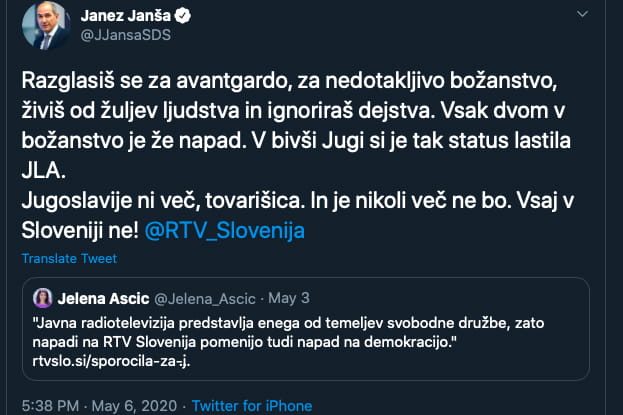
Janez Janša’s Twitter account often sends messages to people he does not agree with like journalist Jelena Aščić. Photo: Katja Lihtenvalner.
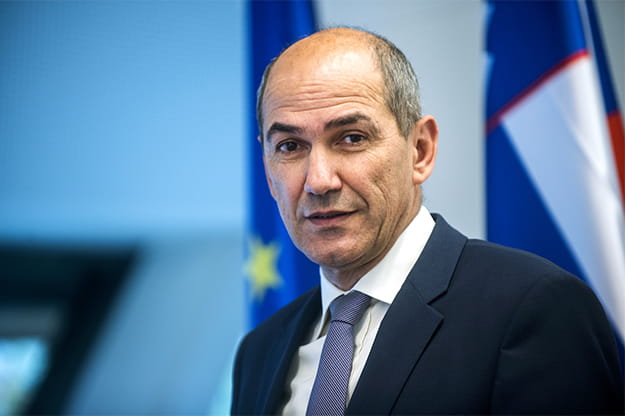
Janez Janša has been in politics almost his entire life, since the ’80s in Yugoslavia, until today. His career, however, has been full of controversies. Photo: Government of Slovenia official site.
From the very start, Janša's career was followed by scandals, and some of his career he spent in prison.
The thin-skinned Janša was very annoyed by allegations of corruption and the protests that followed. In one of his tweets he called the protesters “caviar socialists.”
![“There was a mass turnout of voters and new citizens, with foreign accents,” the text says. “They came to the polls in groups of 10 or more. They wear tracksuits and have voting numbers written on their hands. Outside of the Ljubljana polling station there were small groups of people constantly making phone calls, many of whom were speaking Serbian.”<br />
<br />
The name written under the text was Tomaž Majer, but local journalists had never heard of him, and attempts by local media to find him were unsuccessful. It’s in this context that many have speculated that the real author of the text could have been Janša himself. In protest, a gathering was organized in the center of Ljubljana, with many of those attending dressed in tracksuits.<br />
<br />
“The term trenirkarji [tracksuit-wearers] is an insult in Slovenia used against people from the Yugoslav successor states; a means of exclusion and humiliation,” explains Simona Zavratnik, sociologist and lecturer at the University of Ljubljana’s Faculty of Social Sciences. “In Slovenia, such terms are mainly associated with a specific political party, more precisely, with the SDS and its politicians.”](/_next/image?url=https%3A%2F%2Fadmin.kosovotwopointzero.com%2Fwp-content%2Fuploads%2F2020%2F05%2FSlovenia-and-hate-speech-Photo-2-screenshots-of-twitter-accounts.jpg&w=1920&q=80)
“Opankarski žurnalizem” (Slipper journalism) is how Janša and his followers call the media who oppose them, including the famed Mladina magazine. Photo: Katja Lihtenvalner.
“There was a mass turnout of voters and new citizens, with foreign accents,” the text says. “They came to the polls in groups of 10 or more. They wear tracksuits and have voting numbers written on their hands. Outside of the Ljubljana polling station there were small groups of people constantly making phone calls, many of whom were speaking Serbian.”The name written under the text was Tomaž Majer, but local journalists had never heard of him, and attempts by local media to find him were unsuccessful. It’s in this context that many have speculated that the real author of the text could have been Janša himself. In protest, a gathering was organized in the center of Ljubljana, with many of those attending dressed in tracksuits.“The term trenirkarji [tracksuit-wearers] is an insult in Slovenia used against people from the Yugoslav successor states; a means of exclusion and humiliation,” explains Simona Zavratnik, sociologist and lecturer at the University of Ljubljana’s Faculty of Social Sciences. “In Slovenia, such terms are mainly associated with a specific political party, more precisely, with the SDS and its politicians.”
“Some users on social media would analyse my DNA, my ethnic background and even my facial profile to determine my non-Slovenian roots."
Helena Milinković, journalist.
Journalist Helena Milinković says she has been targeted by Janša’s followers, who call her “mujahed woman.” Photo: Katja Lihtenvalner.
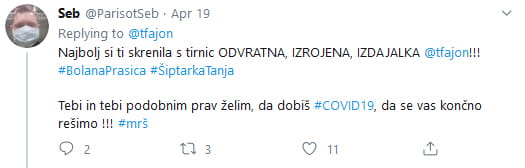
Insults toward European Parliament member Tanja Fajon who supported Kosovo independence is a daily occurrence in Slovenia. Photo: Katja Lihtenvalner.
So far, solidarity has come from different social, environmental and political groups.

Katja Lihtenvalner
Katja Lihtenvalner is a freelance journalist and researcher based in Athens, Greece. Some of the topics she reports on are politics, far-right movements, migration, refugees, prisons and the justice system.